
Overview
What is the Concrete Footing Calculator?
A footing calculator treats the pour as a rectangular prism: trench or pad length, bearing width, and depth below grade (or to the top of the footing). It answers how much concrete fills that box. Frost depth, rebar, and bearing capacity still belong on the drawings.
Footings carry the wall, not the floor slab. Measure the run, width, and depth of each strip or pad, then convert to cubic yards before the excavation crew leaves. This footing page adds waste and bag estimates so you can compare a short ready-mix load with bagged mix on small pads.
Workflow
How does it work?
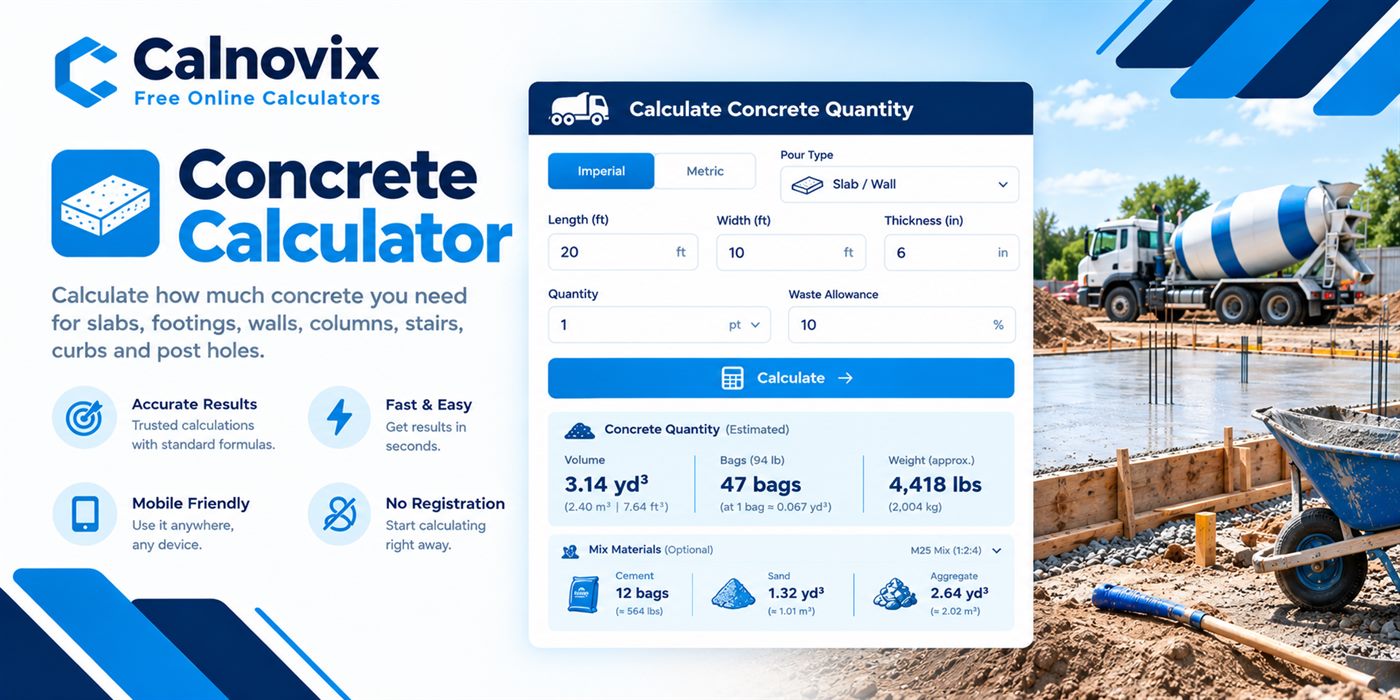
Length, width, and thickness convert to metres, then multiply. Use thickness for footing depth. Quantity repeats identical pads. Waste covers over-dig and sloughing in the trench. Bag and weight outputs use the same yields and density as the main concrete workspace.
Select Imperial or Metric and set depth in inches or millimetres if that matches the drawing.
Keep the pour type on Footing so the fields match a strip or pad.
Enter trench or pad length, bearing width, and footing depth — not the wall height above.
Use quantity for repeated pads; use length for a continuous strip.
Add waste for trench sloughing; 10% is a common starting point in soil that will not stand vertical.
Order from the cubic-yard result, then confirm mix strength with the engineer or supplier.
Math
Formula
Volume = length × width × depth × quantity × (1 + waste%)
A strip footing is a long rectangle; a pad is a short one. Depth is the vertical dimension of the concrete, not the wall that will sit on it. Convert mixed units first. Waste scales the raw volume. Bags and weight are derived after the volume step and do not change the geometry.
Inputs
Step-by-step variables
L
Length
Run of a continuous footing or the long side of a pad.
W
Width
Bearing width of the footing as formed, not the wall thickness above.
D
Depth
Vertical thickness of the footing concrete. Confirm frost and bearing depth on the drawings.
Practice
Step-by-step examples
20 ft strip, 2 ft wide, 12 in deep
A 20 ft continuous footing, 24 inches wide and 12 inches deep, 10% waste. Volume is 20 × 2 × 1 = 40 ft³, or 1.48 yd³ raw.
About 1.63 yd³ with 10% waste. That is typically a short ready-mix load rather than a bag run.
Four 3 × 3 pads at 12 inches
Four isolated pads, each 3 ft × 3 ft × 12 in. One pad is 9 ft³ (0.33 yd³). Four pads are 1.33 yd³ before waste.
About 1.47 yd³ after 10% waste if you set quantity to 4. Keep pad size and depth on the drawing, not from memory.
Where it helps
Use cases
- Continuous wall footings under a stem wall
- Isolated pads for posts or deck piers
- Comparing trench volume with a short ready-mix order
Avoid these
Common mistakes
- Using wall height instead of footing depth.
- Entering the wall thickness as the footing width when the footing is wider than the wall.
- Ignoring over-dig in sandy trenches, which needs extra concrete.
Buying & planning
Tips
- Measure the formed width after excavation, especially if the trench sloughed.
- Keep footing concrete separate from the slab takeoff so you do not double-count.
- Confirm frost depth locally; the calculator will not pick it for you.
Need the bigger picture? Read our calculator disclaimer and accuracy policy.