
Overview
What is the Concrete Calculator?
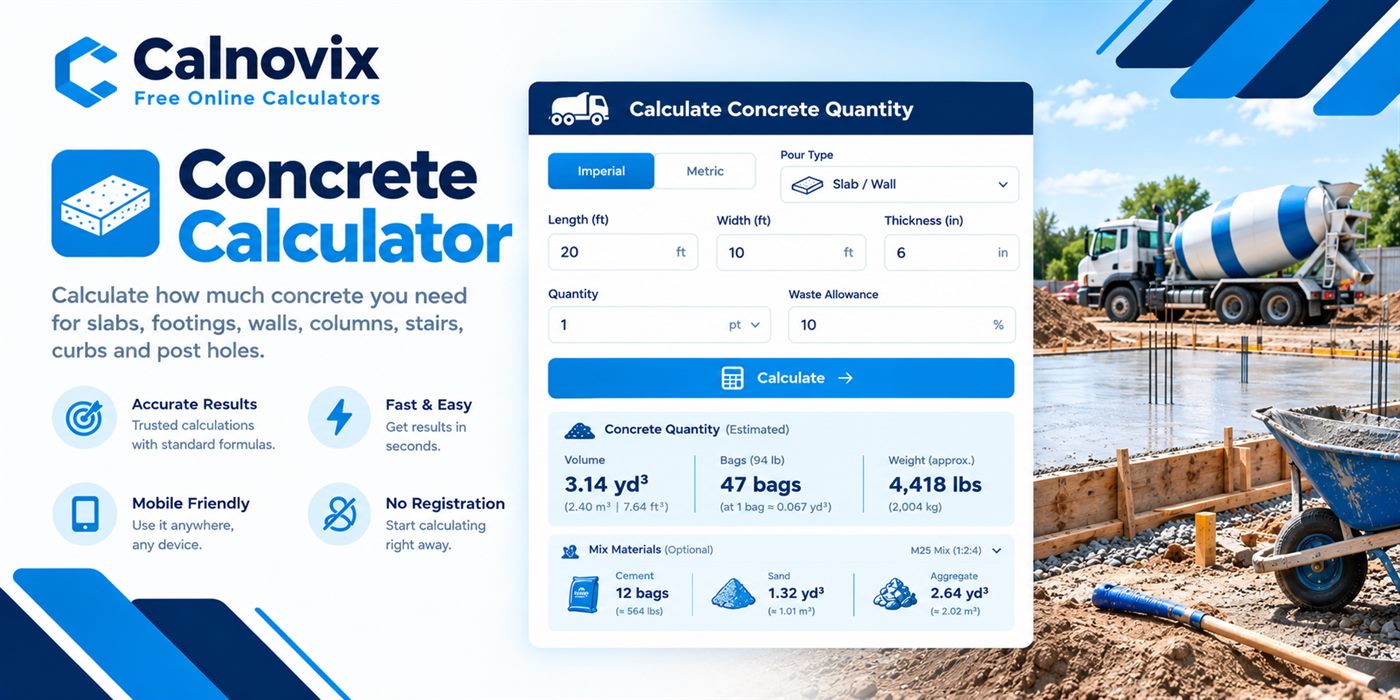
A concrete calculator is a volume estimator for wet concrete. You choose the shape of the pour, enter length, width, thickness (or diameter and height), set how many identical pieces you need, and add a waste percentage. The tool converts mixed units for you — inches for thickness and feet for length, or millimetres and metres — then reports how much concrete to order. It does not design reinforcement, forms, or structural strength; those decisions still belong with drawings, codes, and a qualified professional.
Ordering concrete is unforgiving: too little and the truck leaves before the pour is finished; too much and you pay for material you cannot store. This free concrete calculator turns slab, footing, wall, column, stair, curb, and post-hole dimensions into volume in cubic yards and cubic metres, then estimates bag counts, weight, and optional cement–sand–aggregate quantities so you can phone a ready-mix plant or load bags with a realistic number.

Workflow
How does it work?
Each shape uses a standard geometric volume. Dimensions convert to a common base unit before multiplying, so you are not forced to pre-convert inches to feet by hand. Quantity multiplies the volume for repeated elements such as fence posts. Waste multiplies the raw volume by (1 + waste%/100) to cover spillage, over-excavation, and pump-line leftovers. Bag estimates divide the final volume by typical bag yields; mix grades apply conventional cement:sand:aggregate ratios when you select them.
Choose Imperial or Metric, then set each field’s unit (for example inches for thickness and feet for length).
Select the pour type that matches your forms: slab/wall, round/posts, stairs/curb, or a quick area × thickness slab.
Enter the dimensions that enclose the concrete for that shape.
Set quantity for repeated elements and a waste allowance — 5–10% is typical on residential work.
Optionally pick a mix grade (M10–M25) if you want a cement, sand, and aggregate estimate.
Read cubic yards, cubic metres, cubic feet, bag counts, weight, and mix materials before you order.

Math
Formula
Volume = shape geometry × quantity × (1 + waste%)
Rectangular pours use length × width × thickness (or height). Circular columns and tubes use πr² × height. Stairs and curb sections use the geometry for treads, risers, or curb-and-gutter profiles in the tool. Every dimension converts to metres first so mixed imperial and metric inputs stay consistent. Waste scales the raw volume. Bag counts use published yields for common 40, 50, 60, and 80 lb bags. Mix material splits follow quantity-surveying practice with a wet-volume factor when a grade is selected. Density for weight assumes roughly 2,400 kg/m³ (about 150 lb/ft³) — your supplier’s mix may differ.
Inputs
Step-by-step variables
L
Length
Longest horizontal run of the pour — slab length, wall length, footing run, or column plan dimension.
W
Width
Shorter plan dimension for slabs, footings, walls (thickness of the wall face), or rectangular columns.
T / D
Thickness or depth
Slab thickness or footing depth. Watch the unit: 4 inches is not 4 feet. On metric jobs, 100 mm is a common residential slab thickness.
H
Height
Vertical face of walls and columns, measured from the bottom of the pour to the top of the concrete.
Ø / r
Diameter or radius
For round columns, tubes, and post holes. Enter diameter when the form asks for it; the calculator derives radius as needed.
Q
Quantity
How many identical elements you are pouring — for example eight fence-post holes or four pier footings.
Waste %
Waste allowance
Extra volume for real-world loss. Clean, well-formed pours often use about 5%; slabs on grade and rough excavation commonly use 10%.
Practice
Step-by-step examples
Patio slab with waste (imperial)
You are pouring a 10 ft × 12 ft patio, 4 inches thick (0.333 ft), quantity 1, with 10% waste.
Raw volume ≈ 10 × 12 × 0.333 ≈ 40 ft³ ≈ 1.48 yd³. With 10% waste ≈ 1.63 yd³ (about 1.25 m³). Order at least that much ready-mix, or check bag counts in the results panel.
On site
Real-life examples
Detached garage pad in metres
A homeowner in Ontario needs a 6 m × 6 m garage slab, 100 mm thick, with 10% waste for an uneven gravel base.
Raw volume = 6 × 6 × 0.10 = 3.60 m³. With 10% waste ≈ 3.96 m³ (about 5.18 yd³). That volume usually favours a ready-mix truck over bagged concrete.

Where it helps
Use cases
- Estimating patio, shed, and sidewalk slabs before calling a ready-mix plant
- Sizing continuous footings and pier pads for decks or small additions
- Counting bags for fence posts, mailbox piers, and small repairs
- Comparing cubic yards vs cubic metres when drawings and suppliers use different systems
- Rough cement–sand–aggregate planning when a mix grade is known
Avoid these
Common mistakes
- Treating 4 inches of thickness as 4 feet — the order will be twelve times too large
- Leaving quantity at 1 when you have multiple posts, piers, or footing segments
- Ordering the raw volume with 0% waste on rough ground or pumped pours
- Mixing unit systems without converting (feet for length, inches for thickness) outside a tool that supports per-field units
- Assuming bag yield is identical across brands — always check the manufacturer’s published yield
- Using the volume estimate as a structural design for load-bearing members without an engineer
Deep dive
Concrete volume guide
Why volume comes before price
Concrete is sold by volume. Labour, forms, and rebar matter, but the first number a plant needs is how many cubic yards or cubic metres to load. Getting that number right reduces change orders and emergency second loads.
Choosing a waste percentage
Waste is not padding for poor measuring — it covers predictable site loss. Clean interior forms with experienced crews can sit near 5%. Residential slabs, footings, and pump lines often need closer to 10%. Complex shapes or long hose runs may need more.
- 5% — tidy forms, flat subgrade, short placement distance
- 10% — typical house slabs, footings, and outdoor pads
- 10–15% — rough excavation, many corners, or long pump lines
Metric and imperial on the same site
Canadian drawings frequently use millimetres and metres while some suppliers still quote cubic yards. Reporting both systems side by side helps owners, contractors, and dispatchers stay aligned without silent conversion errors.
Buying & planning
Tips
- Measure thickness in the unit you see on the bag or drawing — then let the calculator convert.
- For slabs on grade, include slope and over-excavation in your waste factor rather than hoping the subgrade is perfect.
- Above roughly one cubic yard (about 0.76 m³), ready-mix is usually cheaper and more consistent than bags.
- Tell the dispatcher volume, strength, slump, and access constraints — not only “a patio’s worth.”
- Stage forms, rebar, and weather checks so the truck is not waiting on an unfinished pour.
- Keep a written note of the calculated yd³/m³ and the waste % you used for the pour-day checklist.
Need the bigger picture? Read our calculator disclaimer and accuracy policy.