
Overview
What is the River Rock Calculator?
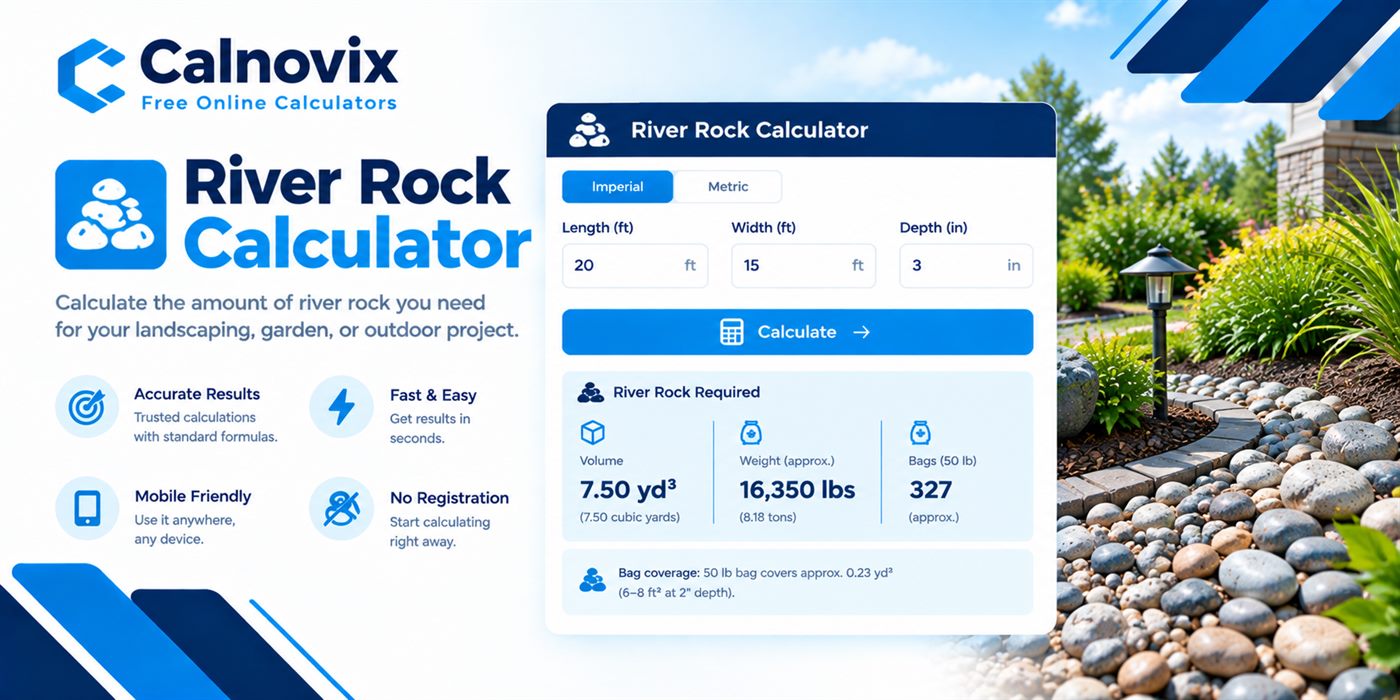
A river rock calculator estimates how much smooth, water-worn decorative stone you need to cover a flat or gently sloped landscape area. River rock — often sold in small, medium, and large size classes — is used for garden accents, dry creek beds, borders, and drainage channels where a natural stone look matters. You enter dimensions or a known area, set depth, choose a density preset or custom value, optionally add waste for spill and settling, and the tool returns volume and approximate weight. It does not design geotextile, edging, or structural drainage — those still depend on your site and local practice.
River rock orders often stumble on the same details: a bed measured in square feet but priced by the cubic yard, a depth written in inches on the plan but sold in bulk tonnes, or a hauler quote that assumes a truck capacity nobody checked before the job. This free river rock calculator turns your garden bed, pathway, patio, or drainage channel plus depth into cubic yards and cubic metres, then estimates US tons, metric tonnes, bag counts, and optional truckloads using typical decorative-stone densities — so you can call a landscape yard in Canada or elsewhere with numbers that match the area you actually measured.

Workflow
How does it work?
Coverage follows area × depth. In rectangle, circle, triangle, or trench mode, the tool computes area from your measurements. In area mode, you enter square feet, square yards, or square metres directly. Known-volume mode converts an existing ft³, yd³, or m³ figure straight to weight. All lengths normalize to metres before multiplying so mixed imperial and metric entries stay consistent. Waste scales the raw volume by (1 + waste%/100). Weight multiplies final volume by a river-rock density preset — small, medium, large, decorative, smooth, or custom kg/m³ from your supplier — then reports kilograms, pounds, US short tons, and metric tonnes alongside bag estimates and optional truckload counts divided by your hauler's US-ton capacity.
Choose Imperial or Metric, then pick a project preset (garden bed, pathway, patio, drainage, and others) or stay on Custom.
Select a river rock type and a rock size class for planning — density presets handle weight; size alone does not set tonnage.
Select a shape — rectangle, circle, triangle, trench, known area, or known volume — that matches how you measured.
Enter length, width, diameter, or area, then set depth using common landscaping depths (1–6 in) or a custom value.
Add a waste percentage — often 5–10% for beds and paths where stone shifts at edges.
Optionally set bag size and truck capacity, then enter a unit price for a materials, delivery, and tax estimate.
Read cubic yards, cubic metres, tons, tonnes, bag counts, and truckload estimates, then copy or share the result.

Math
Formula
Volume = Area × Depth × (1 + waste%)
Area comes from length × width, π × (diameter ÷ 2)² for circles, ½ × base × height for triangles, or a direct area entry. Known-volume mode skips geometry and converts ft³, yd³, or m³ to weight. Waste covers spill at borders and raking loss. Weight = volume × bulk density using small, medium, large, decorative, or smooth river-rock presets — or a custom kg/m³ from your supplier. Rock size is a planning label only; tonnage follows density, not stone diameter alone. Truckloads divide total US tons by your entered hauler capacity.
Inputs
Step-by-step variables
L
Length
Long dimension of a bed, pathway, or drainage trench — measured along the main edge or flow direction.
W
Width
Cross dimension of the coverage zone. For curved paths, split into rectangles or use known-area mode.
D
Depth
Thickness of the river-rock layer. Product guides list inches or millimetres — match the unit selector on the field.
Ø
Diameter
Across a circular accent bed or decorative landscape ring. Area uses radius = diameter ÷ 2.
A
Area
Direct entry in square feet, square yards, or square metres when the footprint is already known.
Waste %
Waste allowance
Extra volume for spill at edging, uneven subgrade, and handling loss during placement.
ρ
Bulk density
Mass per cubic metre for the river-rock type selected. Larger stone often weighs less per cubic metre due to void space.
Practice
Step-by-step examples
Worked example — garden bed (imperial)
A 10 ft × 4 ft bed at 3 in depth with 10% waste and medium river rock (~1,550 kg/m³). Area = 40 ft². Depth 3 in = 0.25 ft. Raw volume ≈ 10 ft³ ≈ 0.37 yd³.
With 10% waste ≈ 0.41 yd³ (about 0.31 m³). Weight ≈ 0.48 metric tonnes — confirm whether your yard sells by the yard or the tonne.
Worked example — drainage trench with truckloads
A 50 ft × 2 ft trench at 6 in depth, 10% waste, large river rock (~1,450 kg/m³), 10 US-ton truck capacity. Area = 100 ft². Raw volume = 50 ft³ ≈ 1.85 yd³.
With 10% waste ≈ 2.04 yd³ (≈ 1.56 m³). Weight ≈ 2.26 metric tonnes (≈ 2.49 US tons) — about one truckload on a 10-ton capacity hauler.
On site
Real-life examples
Real-world — decorative accent bed (metric pricing)
A Calgary homeowner has a 120 ft² (≈ 11 m²) accent bed at 3 in depth, decorative river rock, quoted at $95/yd³ with $75 delivery.
Raw volume ≈ 1.11 yd³; with 5% waste ≈ 1.17 yd³. Material ≈ $111; plus $75 delivery = $186; 13% tax ≈ $24; total landed cost ≈ $210.

Where it helps
Use cases
- Garden and flower bed mulching with decorative river stone
- Pathway and walkway accents between pavers or stepping stones
- Dry creek beds and drainage swales
- Patio borders and seating-area accents
- Comparing bag versus bulk delivery quotes for a landscape renovation
Avoid these
Common mistakes
- Using pea-gravel or crushed-stone density for large decorative river rock
- Entering depth in inches when the form field is set to feet or metres
- Assuming rock diameter alone determines weight without a bulk density figure
- Ordering by square feet without converting to cubic yards or cubic metres
- Treating truckload estimates as exact dispatch schedules without confirming hauler payload
Deep dive
River rock coverage, depth, tonnage, bags, and cost
How river rock coverage is calculated
River rock quantity starts with footprint area multiplied by layer depth. Decorative beds and dry creek features often look shallow on paper but span enough square footage that a half-inch depth error adds up quickly. One cubic yard covers roughly 108 square feet at 3 inches deep, or about 324 square feet at 1 inch — useful sanity checks whether you measured in feet or metres.
Unlike poured concrete, river rock is sold loose. Void space between rounded stones means bulk density is lower than solid rock and varies with size sorting, moisture, and how tightly the pile was screened.
Recommended river rock depth
Depth depends on the visual effect and how the area will be used. Accent beds and tree rings often sit at 2–3 inches (50–75 mm). Pathways and patios commonly use 3–4 inches (75–100 mm) over landscape fabric. Drainage channels and dry creeks may run 4–6 inches (100–150 mm) or deeper where water must move freely — always match local drainage practice.
River rock is generally not a structural driveway surface. If used as a thin decorative layer over a built base, treat depth as a finish course and confirm load requirements separately.
- Flower and garden beds: often 2–3 in (50–75 mm)
- Pathways and walkways: commonly 3–4 in (75–100 mm)
- Patios and seating accents: often 3–4 in (75–100 mm)
- Drainage channels and dry creeks: often 4–6 in (100–150 mm) or more
- Driveways: decorative accent only — not a standalone structural surface
Rock size and density
Suppliers sort river rock into size classes — small (roughly 1–2 in), medium (2–4 in), and large (4–8 in) are common labels, though names vary by yard. Larger stones pack with more air space, so bulk density often drops compared with smaller, tighter material.
This calculator lets you pick a rock size for planning and depth guidance while applying disclosed density presets for weight. Always confirm the bulk density printed on your quote or delivery ticket — moisture after rain can add weight without changing the volume you ordered.
Bags, bulk, and truckloads
Retail bags suit small beds and patch work. Bulk delivery wins when volume approaches a cubic yard or more and you have access for a dump truck. Typical bags run 20 kg, 25 kg, 40 lb, or 50 lb — read the label because colour and size class change even when the weight stays the same.
Truckload estimates divide total US tons by your entered capacity (common planning values: 5, 10, 15, or 20 US tons). Payload limits vary by truck type, region, and material moisture — treat load counts as conversation starters with your hauler, not dispatch guarantees.
Estimating river rock cost
Enter a unit price matching how your supplier sells — per bag, cubic yard, cubic metre, US ton, or metric tonne. The estimate adds optional flat delivery and tax on top of material cost.
Decorative river rock is often priced higher per yard than utilitarian crushed gravel. Compare at least two quotes when volume exceeds one cubic yard, and ask whether delivery minimums apply to your address.
Buying & planning
Tips
- Measure the footprint you will actually cover — curves and irregular beds are easier in known-area mode.
- Larger river rock has more void space and often weighs less per cubic metre than small stone — use the matching density preset.
- Rock size selection is for planning depth and supplier communication; confirm bulk density on the delivery ticket.
- Compare bag pricing against bulk delivery once volume exceeds about one cubic yard.
- Set truck capacity to zero if you are not hauling by tonnage — load counts are estimates only.
Need the bigger picture? Read our calculator disclaimer and accuracy policy.