
Overview
What is the Pea Gravel Calculator?
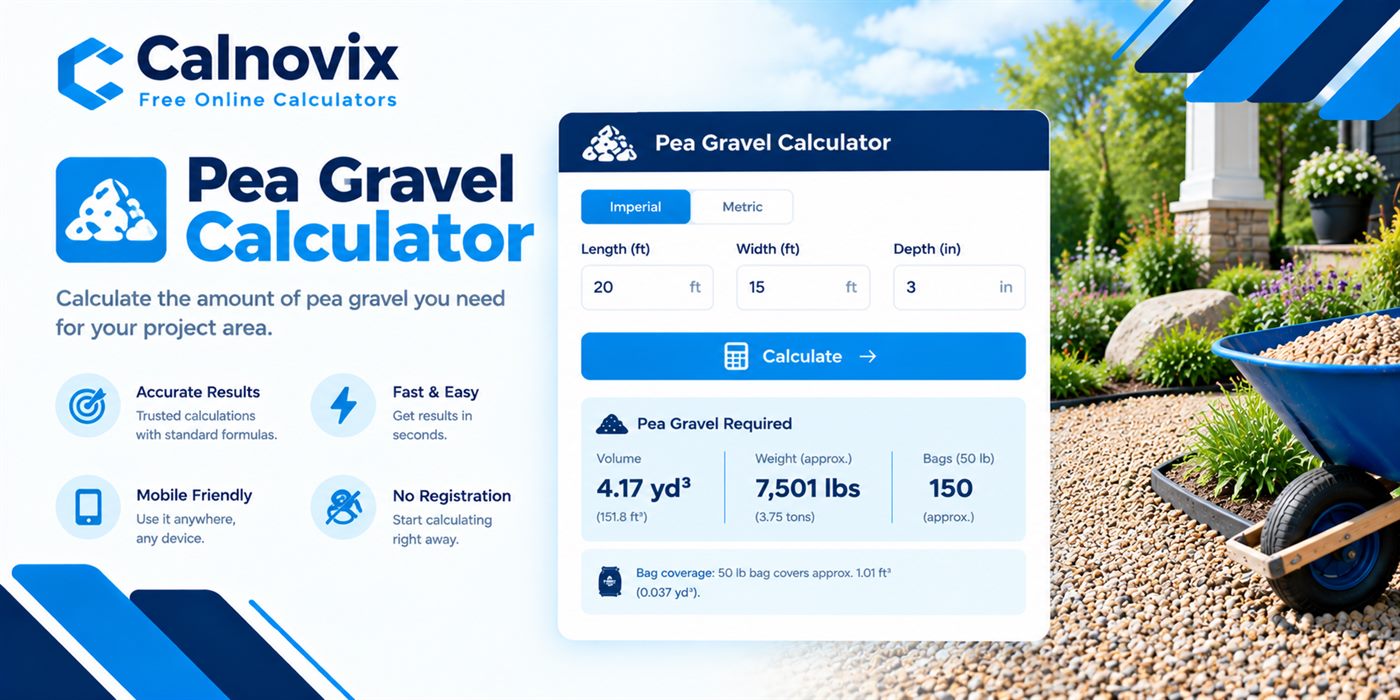
A pea gravel calculator estimates how much smooth, rounded decorative aggregate you need to cover a flat or gently sloped area. Pea gravel — usually about 3/8 to 5/8 inch (9–16 mm) stone — is lighter and more free-draining than crushed angular gravel, which makes it popular for patios, walkways, garden accents, and play areas. You enter dimensions or a known area, set depth, optionally add waste for spill and settling, and the tool returns volume and approximate weight. It does not design edging, geotextile, or structural bases; those still depend on your site and local practice.
Pea gravel looks simple until you order it: a patio sketched in square feet but priced by the cubic yard, a walkway depth written in millimetres on the plan but sold in bulk bags, or a supplier quote in metric tonnes when you measured in feet and inches. This free pea gravel calculator turns your patio, path, or bed footprint plus depth into cubic yards and cubic metres, then estimates US tons, metric tonnes, and bag counts using typical round-stone densities — so you can call a landscape yard in Canada or elsewhere with a number that matches the surface you actually measured.

Workflow
How does it work?
Coverage follows area × depth. In rectangle, circle, triangle, or trench mode, the tool computes area from your measurements. In area mode, you enter square feet, square yards, or square metres directly. Known-volume mode converts an existing ft³, yd³, or m³ figure straight to weight. All lengths normalize to metres before multiplying so mixed imperial and metric entries stay consistent. Waste scales the raw volume by (1 + waste%/100). Weight multiplies final volume by a pea-gravel density preset — standard, dry, wet, or custom kg/m³ from your supplier — then reports kilograms, pounds, US short tons, and metric tonnes alongside bag estimates for common 20 kg, 25 kg, 40 lb, and 50 lb packs.
Choose Imperial or Metric, then pick a project preset (patio, walkway, garden bed, and others) or stay on Custom.
Select a shape — rectangle, circle, triangle, trench, known area, or known volume — that matches how you measured.
Enter length, width, diameter, or area, then set depth in inches, millimetres, or another length unit.
Choose a material preset (standard, dry, or wet pea gravel) or enter a custom density from your yard.
Add a waste percentage — often 5–10% for paths and patios where stone shifts at edges.
Optionally enter a unit price (per bag, cubic yard, cubic metre, ton, or tonne) to see a materials-only cost estimate.
Read cubic yards, cubic metres, tons, tonnes, and bag counts, then copy or share the result.

Math
Formula
Volume = Area × Depth × (1 + waste%)
Area comes from length × width, π × (diameter ÷ 2)² for circles, ½ × base × height for triangles, or a direct area entry. Known-volume mode skips geometry and converts ft³, yd³, or m³ to weight. Waste covers spill at borders, minor settling, and uneven subgrade. Weight = volume × bulk density. Default pea-gravel densities are planning values near 1,400–1,600 kg/m³ depending on moisture; use custom density to match a supplier ticket. Bag counts assume typical 20 kg, 25 kg, 40 lb, and 50 lb poly bags — confirm pack size on the label.
Inputs
Step-by-step variables
L
Length
Long dimension of a patio, walkway, or trench — measured along the direction of travel or the main edge.
W
Width
Cross dimension of the coverage zone. For curved paths, split into rectangles or use average width carefully.
D
Depth
Thickness of the pea-gravel layer. Product guides often list inches or millimetres — do not enter those values as feet or metres.
Ø
Diameter
Across a circular patio, fire-pit ring, or round planter. The calculator uses radius = diameter ÷ 2 for area.
A
Area
Optional direct entry in square feet, square yards, or square metres when the footprint is already known from a plan.
V
Known volume
When a quote or drawing already states cubic feet, yards, or metres — convert straight to weight without re-measuring.
Waste %
Waste allowance
Extra volume for spill at edging, minor settling of round stone, and site loss on uneven ground.
ρ
Bulk density
Mass per cubic metre for standard, dry, wet, or custom pea gravel. Round stone is typically lighter than crushed angular aggregate.
Practice
Step-by-step examples
Worked example — rectangular patio (imperial)
A backyard patio is 14 ft × 10 ft with 3 in of pea gravel and 8% waste. Convert depth: 3 ÷ 12 = 0.25 ft. Area = 140 ft². Raw volume = 140 × 0.25 = 35 ft³ ≈ 1.30 yd³.
With 8% waste ≈ 1.40 yd³ (about 1.07 m³). At standard pea-gravel density (~1,500 kg/m³), weight is roughly 1.6 metric tonnes — confirm whether your yard sells by the yard or the tonne.
On site
Real-life examples
Real-world — front walkway in Vancouver (metric)
A homeowner in British Columbia measured a curved path as roughly 18 m² and wants 50 mm of pea gravel with 10% waste for edge spill around steel edging.
Raw volume = 18 × 0.050 = 0.90 m³; with 10% waste ≈ 0.99 m³ (about 1.29 yd³). Weight near 1.5 tonnes at standard density — two or three bulk bags may cover it, but compare bag price per cubic metre against a small loose delivery.

Where it helps
Use cases
- Backyard patios and seating areas with permeable round-stone surfaces
- Front walkways and side paths where smooth stone is easier underfoot than crushed rock
- Decorative garden beds, tree rings, and dry-creek accents
- Dog runs and play zones that need drainage without sharp angular stone
- Comparing bag packs at a big-box store against a landscape-yard bulk load
- Converting a supplier quote in tonnes when you measured the patio in square feet
Avoid these
Common mistakes
- Entering 3 as feet when the edging guide means 3 inches of depth
- Using crushed-stone or road-base density for smooth pea gravel — round stone weighs less per cubic metre
- Skipping waste on paths with steel or plastic edging where stone spills during raking
- Ordering by US tons when a Canadian yard quotes metric tonnes
- Assuming pea gravel alone supports vehicle traffic on a driveway without a proper base course
- Measuring only the visible stone area and forgetting entrance transitions or step landings
Deep dive
Pea gravel depth, coverage, bags, density, and cost
How pea gravel coverage is calculated
Pea gravel quantity starts with footprint area multiplied by layer depth. Unlike poured concrete, you are filling a shallow open bed — so a small depth error across a large patio changes the order noticeably. One cubic yard covers roughly 108 square feet at 3 inches deep, or about 324 square feet at 1 inch. The calculator handles those conversions whether you measured in feet, inches, metres, or millimetres.
Round stone settles and shifts more than angular crushed rock, which is why many installers add a modest waste percentage even on flat patios. Waste here covers spill at borders and minor raking loss — not structural compaction the way a road base would use.
Pea gravel depth guide
Depth depends on how the surface will be used. Decorative beds and tree rings often sit at 2–3 inches (50–75 mm). Walkways and patios commonly use 2–4 inches (50–100 mm) over a firm, level subgrade. Play areas may go deeper for cushioning — follow product and safety guidance rather than garden defaults.
Pea gravel is generally a poor primary surface for vehicle driveways: round stone rolls and ruts under tire load. If you are topping a properly built base for occasional light use, treat depth as a thin finish layer and confirm structural requirements separately.
- Garden beds and accents: often 2–3 in (50–75 mm)
- Walkways: commonly 2–3 in (50–75 mm)
- Patios and seating areas: often 3–4 in (75–100 mm)
- Play zones: follow manufacturer depth guidance — often deeper than paths
- Driveways: not recommended as a standalone surface; consult base design if used at all
Bags versus bulk delivery
Bags suit small patios, patch repairs, and projects where you cannot store a loose pile. Bulk delivery wins when volume approaches a cubic yard or more and you have driveway access for a dump truck. Typical retail bags run 20 kg, 25 kg, 40 lb, or 50 lb — always read the label because nominal bag weight does not always match the stone colour or source you picked on the shelf.
When comparing options, price the same cubic metres or cubic yards both ways. Bag convenience often costs more per yard on larger patios, but avoids minimum-load delivery fees on small jobs.
Pea gravel density and tonnage
Smooth round pea gravel is typically lighter than angular crushed stone. Planning densities often sit near 1,400 kg/m³ when dry, about 1,500 kg/m³ as a standard default, and up to roughly 1,600 kg/m³ when wet. Moisture fills voids between round particles without changing the volume you need to order.
To convert cubic yards to weight: multiply cubic metres by density for kilograms, then divide by 1,000 for metric tonnes or by 907.185 for US short tons. Canadian suppliers frequently quote tonnes; some cross-border yards quote US tons — this tool shows both.
Estimating pea gravel cost
Enter a unit price matching how your supplier sells — per bag, per cubic yard, per cubic metre, per US ton, or per metric tonne. The estimate covers materials only: edging, landscape fabric, delivery fees, and taxes may apply separately depending on the fields you fill in.
Get at least two quotes when volume exceeds one yard. Bulk pea gravel from a landscape yard is often cheaper per cubic metre than stacked retail bags, but delivery minimums can change the math on smaller paths.
Buying & planning
Tips
- Pea gravel moves underfoot — plan edging (steel, brick, or concrete kerb) before you finalize volume.
- Compact the subgrade and consider landscape fabric if weeds are a concern; the calculator does not include fabric or edging quantities.
- Wet pea gravel weighs more per cubic metre — pick the wet preset if stone will arrive damp from outdoor storage.
- For irregular patios, split the plan into rectangles, calculate each, and add the volumes.
- Keep both yd³ and tonnes on your order note when comparing a bag run from a home centre against a bulk delivery.
- Rake to a consistent depth; round stone hides thin spots less forgivingly than mulch.
Need the bigger picture? Read our calculator disclaimer and accuracy policy.