
Overview
What is the BMI Calculator?
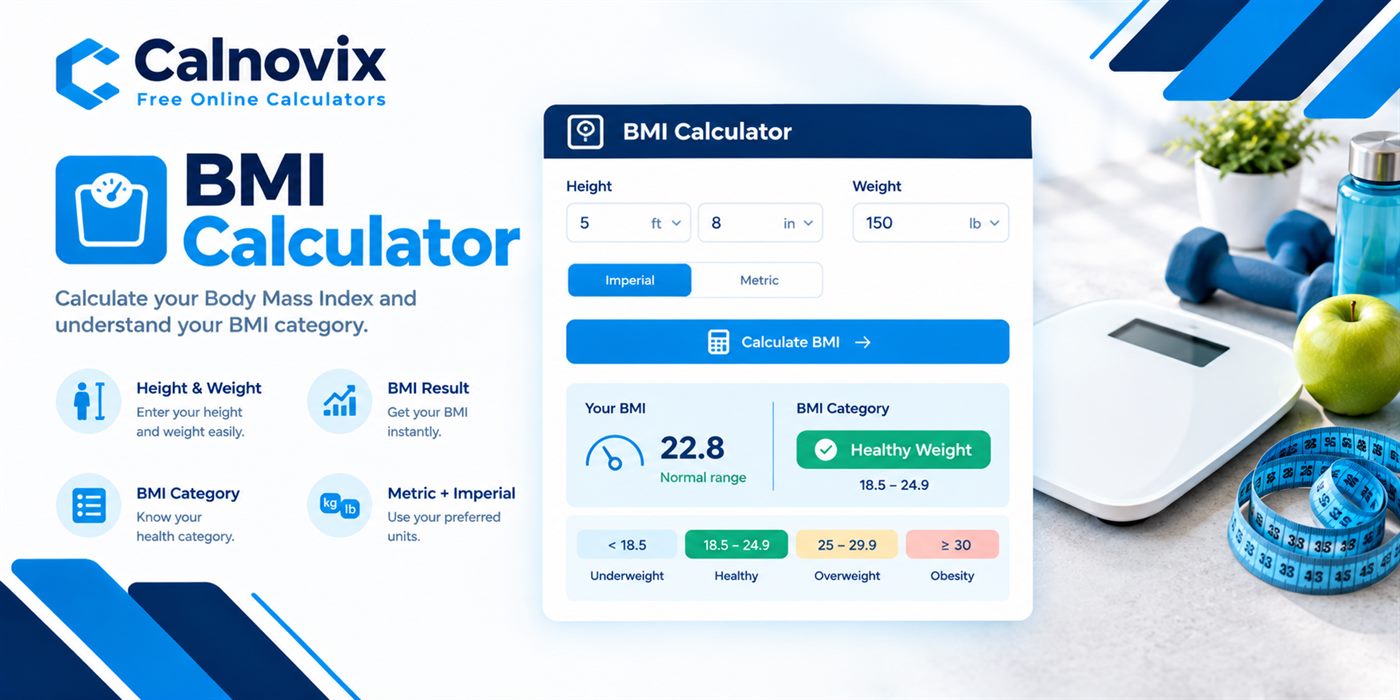
BMI (body mass index) equals weight in kilograms divided by height in metres squared. Public-health programmes use it because it is simple and comparable across large populations. It does not measure body fat directly, so muscular athletes, older adults, and some ethnic groups may fall outside the category that matches their metabolic health. Treat the number as a starting point for conversation, not a label.
Body mass index is a quick height-and-weight ratio used worldwide as a screening signal — not a full health assessment. This free BMI calculator converts your measurements into an adult BMI value and maps it to widely used categories so you can see where a single reading sits, then decide whether to dig deeper with a clinician.
Workflow
How does it work?
You choose metric or imperial units, enter weight and height, and the calculator converts everything to kilograms and metres before applying BMI = kg ÷ m². The result is rounded for readability and matched to adult category bands commonly used in WHO communication: underweight, normal, overweight, and obese. Imperial height is accepted as feet plus inches so you do not need to pre-convert to centimetres.
Select Metric (kg and cm) or Imperial (lb, feet, and inches).
Enter your current weight without guessing — use a recent scale reading if you can.
Enter your height carefully; a small height error changes BMI more than people expect.
Review the BMI value and category in the results panel.
Read the category ranges and sources, then discuss personal context with a health professional if needed.
Math
Formula
BMI = weight (kg) ÷ [height (m)]²
Weight must be in kilograms and height in metres. Imperial inputs are converted first: pounds to kilograms, and feet/inches to centimetres then metres. The squared height term means height errors are magnified. Adult category cut-offs used here follow common WHO banding for adults (under 18.5 underweight; 18.5–24.9 normal; 25–29.9 overweight; 30 and above obese). Paediatric BMI uses age- and sex-specific percentiles and is outside the scope of this adult tool.
Inputs
Step-by-step variables
W
Weight
Body weight in kilograms or pounds. Weigh at a consistent time of day for repeat comparisons.
H
Height
Standing height without shoes. Metric uses centimetres; imperial uses feet and inches.
m
Height in metres
Height converted to metres for the formula. Example: 170 cm → 1.70 m.
BMI
Body mass index
The unitless ratio kg/m², typically shown to one decimal place for screening.
Practice
Step-by-step examples
Metric adult example
An adult weighs 70 kg and is 170 cm tall (1.70 m).
BMI = 70 ÷ (1.70 × 1.70) = 70 ÷ 2.89 ≈ 24.2, which falls in the normal adult band under common WHO cut-offs.
On site
Real-life examples
Imperial reading before a clinic visit
Someone weighs 180 lb and is 5 ft 10 in, and wants a number to bring to a routine checkup.
After conversion, BMI is about 25.8 — just into the overweight band. That is a screening signal only; muscle mass, waist size, and lab work still matter for clinical decisions.
Where it helps
Use cases
- Getting a quick adult BMI before a primary-care appointment
- Comparing metric and imperial measurements without hand conversion
- Tracking BMI trend over months alongside waist circumference notes
- Teaching students how the kg/m² formula behaves when height changes
- Checking which broad WHO category a single reading falls into
Avoid these
Common mistakes
- Using this adult calculator for children or teens (they need percentile charts)
- Entering height in centimetres while leaving the tool in imperial mode
- Treating BMI as a direct measure of body fat or fitness
- Ignoring pregnancy, oedema, or limb loss, which distort weight-based ratios
- Obsessing over a single decimal place instead of longer-term trends
- Self-diagnosing disease from a BMI category alone
Buying & planning
Tips
- Measure height against a wall without shoes; round carefully.
- If you lift weights regularly, ask a clinician how to interpret BMI alongside muscle mass.
- Pair BMI with waist circumference and lifestyle context for a fuller picture.
- Re-check after meaningful weight change rather than daily noise on the scale.
- Bring both the number and your measurement units to appointments to avoid mix-ups.
- Use official sources linked below when you need the underlying classification definitions.
Need the bigger picture? Read our calculator disclaimer and accuracy policy.